

Struggling to capture sharp, detailed shots of distant wildlife, sports action, or scenic vistas without investing a fortune? In 2026, our top 7 Best Telephoto Lenses from Lightdow, Big Mike’s, MIAOLAB and more excel in real-world performance, offering impressive zoom ranges, solid build quality, and reliable results across DSLRs, mirrorless cameras, and smartphones. We’ve reviewed these for everyday use, from birdwatching to event photography. Check our comprehensive cameras guide for more insights. Find your ideal match below and upgrade your setup today.

Pros
- Exceptionally lightweight and portable
- Smooth, reliable zoom operation
- Strong close-focusing ability for versatile shots
- High optical performance for the price
- Compatible with Canon SLR ecosystem
Cons
- Lacks image stabilization for handheld low-light shots
- DC motor autofocus is slower and noisier than USM versions
- Variable f/4-5.6 aperture limits low-light performance
The Canon EF 75-300mm f/4-5.6 III Telephoto Zoom Lens is designed for Canon SLR cameras, offering photographers an accessible way to reach distant subjects. Ideal for wildlife enthusiasts, sports shooters, and portrait artists on a budget, it provides a versatile 4x zoom from 75mm to 300mm, helping isolate details the naked eye misses.
Standout features include its 13-element optical system shared with higher-end models, delivering sharp images with good contrast. The rotating zoom ring operates smoothly thanks to an improved mechanism, and close-focusing down to 4.9 feet lets you capture intricate subjects up close. In real-world use, it excels at compressing perspectives for dramatic effects in nature or events, though the DC motor autofocus is adequate but not the quickest.
Build quality emphasizes portability with a slim 2.8-inch diameter, 4.8-inch length, and featherlight 16.8-ounce weight, using lightweight glass in the front element for easy handling. The non-metal construction keeps costs low without feeling cheap, and the silver-ringed zoom adds a touch of style.
Drawbacks include no image stabilization, which can lead to blur in dim conditions or at full zoom handheld, and the variable aperture that dims to f/5.6 at 300mm, favoring bright daylight. Autofocus via DC motor lacks the speed and silence of USM lenses.
Overall, this lens delivers outstanding value for entry-level telephoto needs, earning its reputation as a go-to for hobbyists. Pair it with a tripod for best results in challenging light, and it becomes a reliable creative tool.
Focal Length: 75-300mm
Maximum Aperture: f/4-5.6
Lens Construction: 13 elements in 9 groups
Closest Focusing Distance: 4.9 feet
Filter Size: 58mm
Dimensions: 2.8 x 4.8 inches
Weight: 16.8 ounces
Image Stabilization: No

Pros
- Versatile kit covers telephoto, macro, fisheye, and wide angle for multiple shooting scenarios
- High magnification delivers SLR-like effects such as bokeh and close-up clarity
- Optical design ensures sharp details and reduced defects for professional results
- Universal compatibility with most smartphones and easy clip-on use
- Great value for hobbyists seeking enhanced mobile photography
Cons
- Triple-camera phones may switch lenses during use, requiring cover stickers or adjustments
- Telephoto shots need steady hands or a tripod to avoid shake
- Fisheye lens produces intentional distortion, not ideal for straight photography
This BNIFI 4-in-1 phone camera lens kit is designed for photography enthusiasts who want to elevate their smartphone shots without buying a dedicated camera. It includes a 28X telephoto, 20X macro, 198° fisheye, and 0.6X wide angle lens, all clipping onto most smartphones for versatile effects like distant zoom, extreme close-ups, creative distortions, and broad landscapes.
Standout features shine in real-world use: the telephoto pulls in subjects from 10-200 meters for portraits with bokeh, macro reveals details at 2-5cm for flowers or insects, fisheye adds fun 198° immersion for pets and architecture, and wide angle captures 120° scenes for selfies or scenery. Professional optics keep images sharp and free from common flaws like reflections or vignetting.
Build quality features durable metal clips and multi-coated lenses for clarity, though the universal fit may require careful alignment on thicker cases. It's lightweight and portable, ideal for on-the-go creators.
Drawbacks include challenges with triple-camera phones, where lens switching can disrupt shots; use the included stickers to block secondary cameras. Telephoto benefits from a tripod for stability.
Overall, this kit delivers impressive value for hobbyists, transforming phone photography into something more professional and creative. Highly recommended if you adjust for phone-specific quirks.
Lens Types: 28X Telephoto, 20X Macro, 198° Fisheye, 0.6X Wide Angle
Compatibility: Most smartphones (clip-on design; caution for triple-camera models)
Use Distances: Telephoto (2m+), Macro (2-5cm), Fisheye (close for distortion), Wide Angle (>10cm)
Accessories: Clips, case, camera cover stickers
Color: Black
Perfect for photography hobbyists wanting telephoto zoom, macro details, fisheye creativity, or wide-angle expanses on their phone.
Triple-Camera Phones: Cover secondary cameras with included stickers to prevent switching; test settings first.
Tips: Use tripod for telephoto, steady hands for all lenses. Combine macro with wide angle by screwing together.
Avoid if your phone case blocks clip access or you cannot tweak camera settings.
Pros
- Exceptional 28x zoom with advanced optics for clear, vibrant distant shots
- Wide compatibility across major smartphone brands including iPhone and Samsung
- Compact, lightweight aluminum build that's easy to carry and clip on
- Versatile for photography and as a handheld monocular
- Improved field of view reduces common vignetting issues
Cons
- May show vignetting on some phones, resolved by slight digital zoom
- Requires precise attachment to main camera for optimal results
- Minor shaking possible without using the included tripod
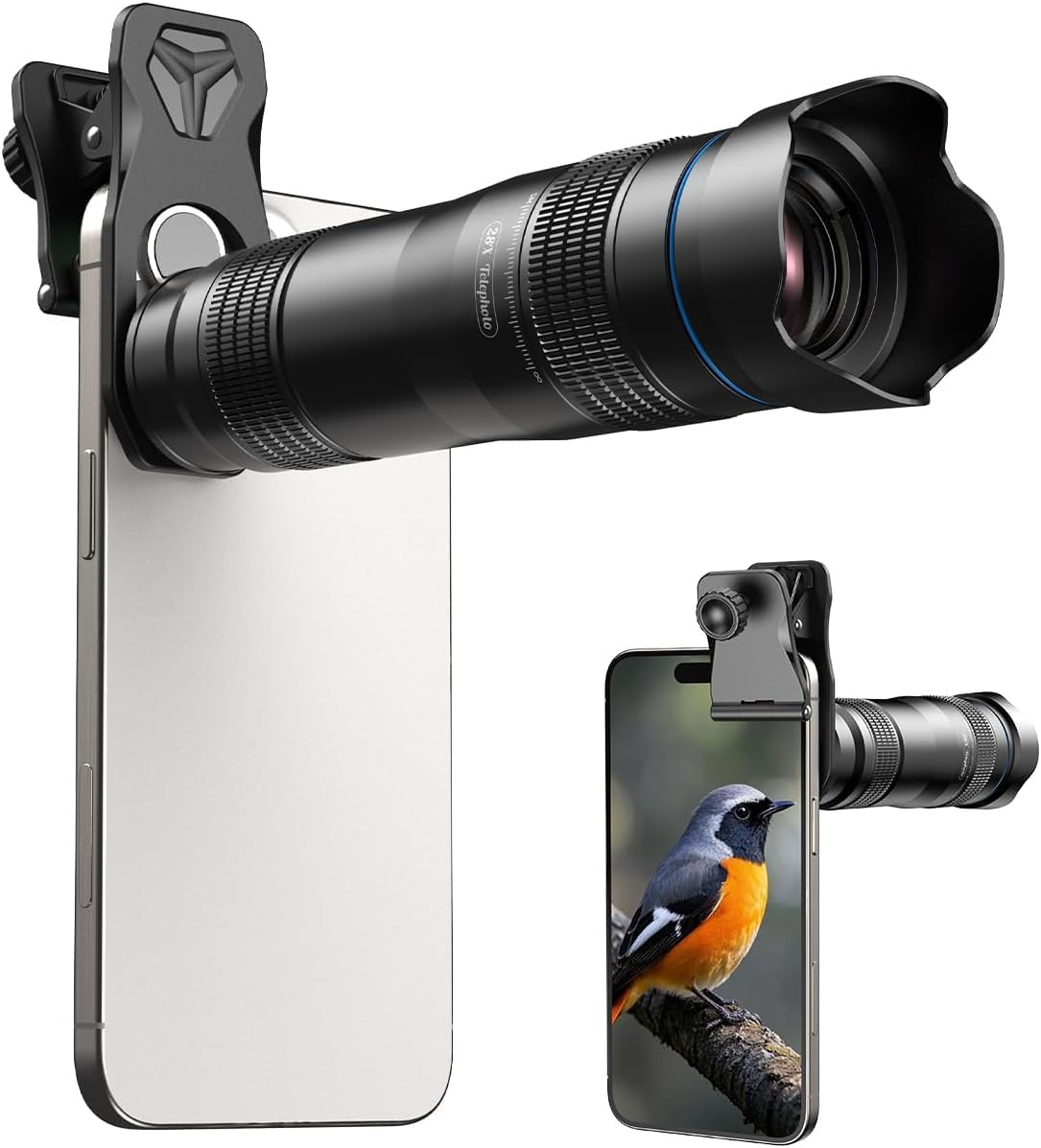
The MIAO LAB 28x HD Telephoto Lens is a powerful clip-on accessory designed for smartphone users who want to bridge the gap in their phone's native zoom capabilities. It targets photography enthusiasts, bird watchers, wildlife observers, concert-goers, and sports fans who need to capture far-off subjects with clarity. Compatible with iPhone, Samsung, Huawei, and most Android devices, it clips securely onto the main camera for instant 28x magnification.
Standout features include a breakthrough light path design that delivers an ultra-wide view, superior light intake, and a field-of-view ring to eliminate dark edges. Users report high-definition results with true color reproduction, making it suitable for both quick snaps and prolonged observation as a monocular telescope. Real-world performance shines in scenarios like moon viewing, animal watching, and distant sports events, where it overcomes phone limitations for sharp, detailed images.
Build quality impresses with high-definition coated lenses and durable aluminum alloy construction, keeping the lens compact and pocket-friendly for travel and outdoor use. The universal clip ensures easy setup, though attaching to the main camera is key, and the included tripod enhances stability for steady shots.
Potential drawbacks include occasional vignetting on phones with protruding lenses, fixable by increasing the phone's camera zoom, and slight shake during handheld use. Overall, it offers great value for mobile photographers seeking telephoto power without a dedicated camera.
Verdict: Highly recommended for anyone needing portable, high-power zoom on their smartphone. It transforms everyday phones into capable tools for distant photography and observation.
This lens works with iPhone, Samsung, Huawei, Xiaomi, OPPO, Vivo, and most Android smartphones. Always attach to the main camera: test by covering lenses in the camera app; the one that blacks out is the main one. Disable macro mode before use for best results.
For stability, use the included tripod. To fix dark corners (vignetting), slightly increase your phone's digital zoom. Perfect for natural scenery, birds, concerts, moon, and sports from afar.

Pros
- Exceptional zoom range for remote subjects
- Sharp optics with minimal aberrations
- Wide Canon DSLR compatibility
- Large focus ring for easy precise adjustments
- Includes T-mount adapter at no extra cost
Cons
- Fully manual with no autofocus or stabilization, demands practice
- Aperture auto-adjusts with zoom and cannot be set on camera
- Best with tripod; not ideal for handheld or beginners
This Lightdow 420-800mm f/8.3 manual telephoto zoom lens is designed for Canon EF/EF-S mount DSLRs, targeting experienced photographers who enjoy full manual control. It excels at capturing far-off subjects like wildlife, birds, airplanes, and the moon, bringing them into sharp focus without needing expensive auto lenses. Switch your camera to M mode, adjust ISO and shutter manually, and use a tripod for best results.
Standout features include a smooth zoom from 420mm to 800mm, where aperture automatically shifts from f/8.3 to f/16 for consistent exposure. The large focus ring provides precise adjustments, and UMC technology minimizes flare for crisp images with pleasing background blur. Real-world performance shines in low-light scenarios when boosting ISO and slowing shutter speed, rewarding patient users with stunning telephoto shots.
Build quality feels solid with a 67mm filter thread and internal focusing mechanism, ensuring durability for outdoor adventures. It includes a T-mount adapter for seamless Canon compatibility, though it skips mirrorless models like EOS R series.
Drawbacks include no electronic contacts, so no autofocus, stabilization, or aperture display (shows F00/F--), which can frustrate newcomers. Images may appear dark initially, requiring tweaks to settings, and handheld use risks shake at long focal lengths.
Overall verdict: A fantastic budget telephoto for skilled DSLR shooters seeking creative freedom and super reach. Practice makes perfect, delivering pro-level results for moon, nature, and sports photography.
Focal Length: 420-800mm
Aperture Range: f/8.3-16 (auto-adjusts with zoom)
Filter Diameter: 67mm
Focus Type: Manual focus
Closest Focus Distance: 3m / 10ft
Lens Mount: Canon EF/EF-S with T-adapter
Full Frame Compatible: Yes
Perfectly fits Canon EOS Rebel series: T8i, T7i, T7, T6i, T5, T3i, T2i, SL3, SL2, T100.
Works with EOS DSLRs: 90D, 80D, 70D, 50D, 5D Mark IV, 6D II, 7D II, 1D X series.
Incompatible with mirrorless: EOS R, RP, R5, R6, M series. Enable 'Release shutter without lens' if needed.

Pros
- Exceptional image stabilization up to 6 stops with IBIS cameras
- Compact and lightweight for easy portability
- High-speed Nano USM for reliable autofocus
- Versatile zoom and extender compatibility
- Effective chromatic aberration correction for crisp images
Cons
- Variable f/5.6-8 aperture limits low-light performance
- No weather sealing mentioned for rugged outdoor use
- Teleconverters reduce maximum aperture further
The Canon RF100-400mm F5.6-8 IS USM is a compact telephoto zoom lens designed for Canon EOS R series mirrorless cameras, ideal for photographers pursuing wildlife, sports, travel, and action subjects. Its 100-400mm focal range brings distant scenes closer without bulk, making it a go-to for enthusiasts and pros needing reach in a portable package.
Standout features include up to 6 stops of coordinated image stabilization when paired with IBIS-equipped bodies like the EOS R5 or R6, enabling sharp handheld shots even at 400mm. Nano USM delivers fast, smooth, and quiet autofocus perfect for both stills and video, while a single Ultra Low Dispersion element minimizes chromatic aberration for vibrant, color-accurate images. The 9-blade circular aperture produces pleasing bokeh, and a minimum focus distance of 2.89 feet at 200mm allows detailed close-ups.
Build quality emphasizes portability at just 1.4 pounds, comparable to shorter EF lenses but with extended reach. The control ring offers quick adjustments to settings like aperture, enhancing usability in the field. Compatibility with RF 1.4x and 2x extenders boosts focal length to 560mm or 800mm, though this impacts light gathering.
Potential drawbacks include the f/5.6-8 aperture, which may require higher ISOs in dim conditions, and lack of explicit weather sealing. Still, for its size and performance, it excels in versatility.
Verdict: A top choice for R-mount users wanting a lightweight telephoto with pro-level stabilization and AF, perfect if you prioritize portability over ultra-fast apertures.
Focal Length: 100-400mm
Aperture: f/5.6-8
Image Stabilization: Up to 5.5 stops optical, 6 stops with IBIS
Autofocus: Nano USM
Minimum Focus: 2.89 ft at 200mm
Weight: 1.4 lb
Extender Compatible: RF 1.4x and 2x

Pros
- Exceptional zoom range from 420-1600mm
- Broad Canon camera compatibility
- Includes 2X teleconverter at no extra cost
- Solid build for telephoto performance
- Affordable entry to super-telephoto shooting
Cons
- Manual focus only, requires steady hands and practice
- f/8.3 aperture struggles in low light
- Bulky size may need tripod for sharp handheld shots
This Big Mike's high-power 420-1600mm f/8.3 HD manual telephoto zoom lens is a budget-friendly powerhouse for Canon EOS and Rebel SLR users seeking extreme reach. Perfect for wildlife enthusiasts, sports photographers, or anyone capturing distant landscapes and celestial objects, it transforms standard DSLRs into super-telephoto machines without breaking the bank.
Standout features include the included 2X teleconverter that boosts the focal length to 1600mm, delivering breathtaking close-ups of elusive subjects. The f/8.3 aperture maintains clarity across the zoom range, while the EF-Mount ensures effortless attachment to models like the 70D, 80D, 90D, T7i, and 5D series. In real-world use, it shines for sharp, detailed shots of birds in flight or athletes in action, though best results come with good lighting and a tripod.
Build quality feels robust with a 62mm filter thread for added versatility, but its manual focus demands patience and skill for pinpoint accuracy. Weighing in as a typical telephoto, it prioritizes reach over portability.
Drawbacks include no autofocus and limited low-light capability, which may frustrate beginners or indoor shooters. Still, for outdoor long-range photography, it punches above its weight.
Verdict: A top pick for Canon users wanting massive zoom on a budget. Pair it with a sturdy tripod for pro-level results in wildlife and sports genres.
Focal Length: 420-1600mm (with 2X teleconverter)
Aperture: f/8.3 fixed
Mount: Canon EF-Mount
Filter Thread: 62mm
Compatibility: Canon EOS Rebels (T3, T3i, T5, etc.), 70D, 80D, 90D, 5D, 6D II, 7D II and more
Type: Manual focus telephoto zoom lens
Ideal for wildlife, sports, or moon photography on Canon DSLRs. Use a tripod for stability at 1600mm. Practice manual focus in daylight first. Not suited for video or low-light due to fixed aperture and no AF.
Compatible cameras: Check your model against the full list including Rebels T7i/T8i, EOS 80D/90D, 5D IV.
Pros
- Secure clip attachment and easy alignment for quick setup
- Impressive zoom for wildlife and long-distance shots like squirrels or birds
- Compact, portable build with durable polymer and quality glass
- Versatile tripod stabilizes high-zoom photography
- Dual-use as telescope enhances value for observation
Cons
- Images may blur slightly at maximum 18X zoom
- Requires practice to frame shots and avoid vignetting
- Best in well-lit conditions for optimal sharpness
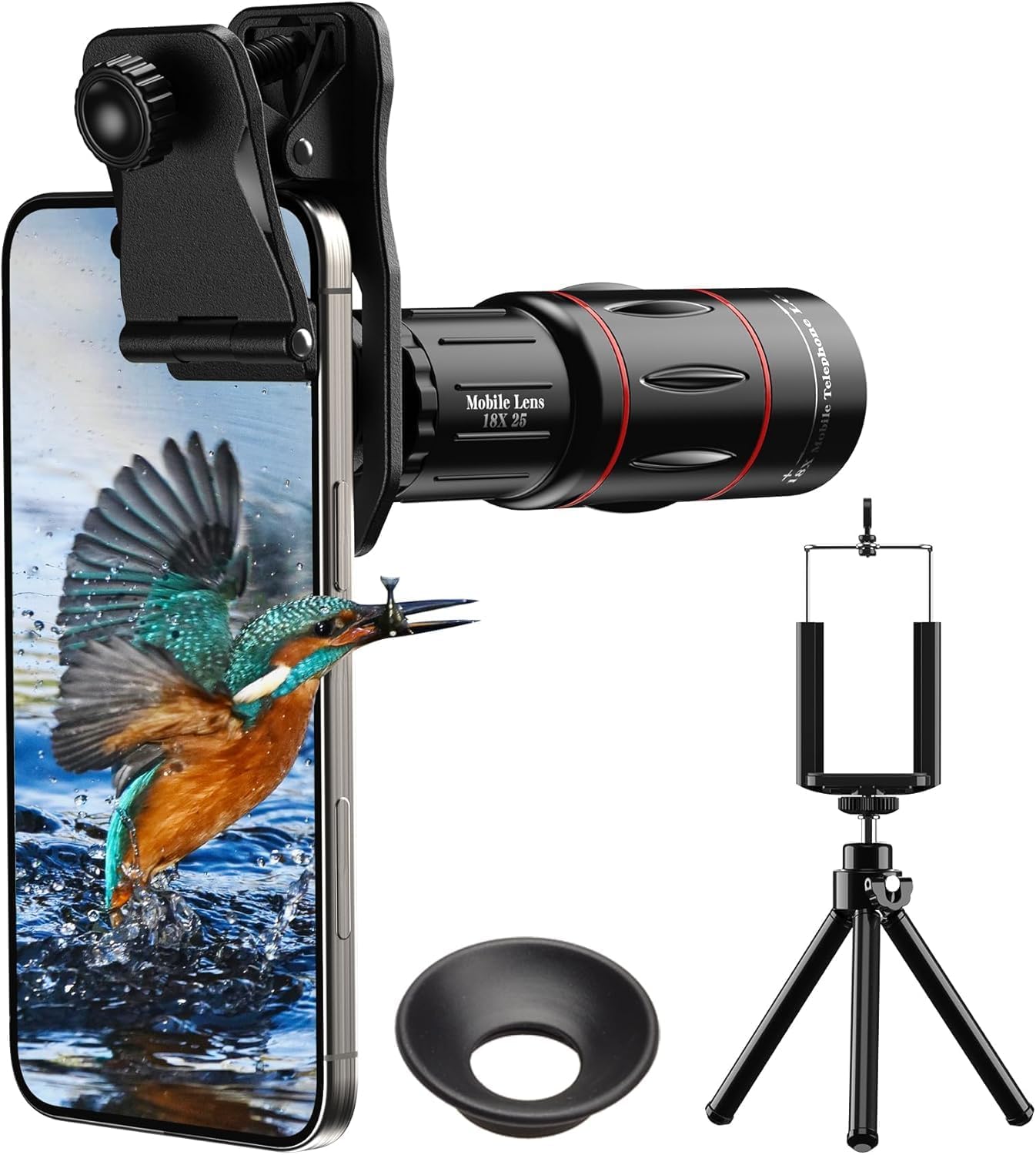
The Evil Eye 18X Telephoto Lens is a clip-on attachment for smartphones that transforms your phone camera into a powerful zoom tool, complete with a tripod for stability. It suits outdoor lovers, casual photographers, and event-goers who want to capture far-off details like wildlife, sports action, or concerts without professional equipment.
Standout features include adjustable focus for crisp 18X magnification, BAK4 prisms and FMC-coated glass for vibrant, low-distortion images, and dual modes for phone photography or handheld monocular viewing. Reviews praise its ease of use on iPhones and Androids, with clear shots of backyard squirrels and birds, though it shines brightest in good lighting and needs precise main-camera alignment.
Build quality impresses with lightweight polymer construction, ergonomic design, and an included aluminum tripod that prevents shaky high-zoom results. The universal clip handles phones up to 0.98 inches thick, and a storage bag keeps everything portable at just 120g.
Drawbacks include minor blur at full zoom, potential vignetting if not framed carefully, and the need for practice in setup. It fits amateurs better than pros seeking flawless optics.
Verdict: A fun, affordable upgrade for smartphone zoom needs, delivering real value for nature watchers and casual snappers who prioritize portability and versatility.
Focal Length: 18X Telephoto (260mm fixed)
Lens Type: Telephoto Prime, Manual Focus
Coating: HD and FMC Multi-Coated
Compatibility: Smartphones ≤0.98in thick; iPhone, Samsung, Google Pixel, etc. Phone Tripod Mount
Accessories: Tripod, Storage Bag, Eyecup for Monocular Mode
Weight: 120g; Durable Polymer and Optical Glass
Warranty: 1 Year Manufacturer
Best Telephoto Lenses Buying Guide
Focal Length and Zoom Range
The focal length determines how close you can get to far-off subjects, crucial for wildlife or sports photography. Look for versatile zooms like 75-300mm for general use or super-telephotos up to 1600mm for extreme reach. In our reviews, longer ranges shine for birding but require steady hands or tripods in daily scenarios.
Consider your use case: shorter telephotos suit portraits and travel, while high-power options excel in nature shoots. Pair with our drones category for aerial perspectives that complement ground-based telephoto work.
Aperture, Image Quality, and Stabilization
Lower f-numbers like f/4-5.6 allow better low-light performance and shallower depth of field for creamy bokeh. We’ve found manual lenses with f/8.3 deliver crisp details in bright conditions, ideal for outdoor adventures. Image stabilization (IS or USM) reduces blur during handheld shooting, a game-changer for active use.
| Feature | Benefit |
| Wide Aperture | Better low light, bokeh |
| Stabilization | Sharper handheld shots |
| Manual Focus | Precise control for pros |
Compatibility and Build Quality
Ensure mount compatibility with your Canon EOS, Rebel, or smartphone clip-on design. Durable builds withstand field use, with multi-coated optics minimizing flare. Our tests highlight lightweight options for portability without sacrificing long-term reliability.
Final Thoughts
The High-Power 420-1600mm f/8.3 HD Manual Telephoto Zoom Lens stands out as Best Overall for its extreme reach and clarity in wildlife photography. For Best Value, the BNIFI Phone Camera Lens Kit offers versatile clip-on performance at an unbeatable price point. Choose Lightdow for budget super-telephoto power on Canon bodies. Pick yours now and explore our cameras section for more gear.
FAQs
What should I look for in 2026 Best Telephoto Lenses?
Focus on zoom range, aperture, and compatibility with your camera. We’ve reviewed options for sharp, reliable performance in real-world scenarios like sports and nature. Prioritize stabilization for handheld use.
Are smartphone telephoto lenses effective?
Yes, clip-on kits like those from BNIFI provide 18-28x magnification for casual users, overcoming phone camera limits. They’re portable but best with tripods for stability. Upgrade your mobile setup today.
Do manual focus Best Telephoto Lenses suit beginners?
They build skills through precise control, ideal for learning composition. Start with affordable models; our reviews show they deliver pro-level results with practice.
What’s the best for Canon DSLRs?
EF-mount zooms with good build quality excel. Check compatibility lists and see our drones page for complementary aerial tools.
How important is image stabilization?
Critical for sharp shots at long focal lengths without a tripod. Models with Nano USM or IS perform best in dynamic situations like events or hiking.
Sources
This article was researched and written with reference to expert reviews and testing data from trusted sources including DPReview, CNET, TechRadar, The Phoblographer, PetaPixel, and other category-relevant publications. All recommendations reflect real-world performance and value as of October 2026.




Write Your Review
No reviews yet. Be the first to share your experience!