

Struggling with camera shake in long exposures or imprecise timing for breathtaking time-lapses in 2026? We’ve reviewed the 6 Best Intervalometers from JJC, Pixel to bring you reliable tools that enhance accuracy, compatibility, and creative control for photographers. Dive deeper with our cameras category guide. Find your ideal match below and upgrade your setup today.

Pros
- Ultra-precise timing up to 99:59:59 for professional time-lapse projects
- Multiple modes including self-timer, continuous, and long exposure
- Broad compatibility with Canon EOS Rebel, R series, and more
- Compact design with humanized backlight for low-light use
- Functions without batteries as a basic wired shutter release
Cons
- No memory function; settings reset when powered off
- Cannot control video recording or lens zoom
- Maximum timer limited to under 100 hours, requiring reset for longer projects
The JJC Intervalometer is a versatile wired timer remote designed for Canon EOS photographers, including Rebel T7, T6, 90D, 80D, R6, R10, and RP models. It excels in time-lapse photography, allowing users to set delays, exposure times, and intervals up to 99 hours 59 minutes 59 seconds, with options for 1-399 shots or unlimited. Ideal for capturing dynamic scenes like blooming flowers, waterfalls, or traffic streams without introducing camera shake.
Standout features include self-timer, continuous shooting, long exposure timer, and a bulb mode slider for extended shots. In real-world use, it delivers reliable performance for astrophotography or nature sequences, with the interval including exposure time for accurate spacing, such as 10-second exposures every 15 seconds for a 5-second gap. The backlit LCD makes adjustments simple in dark conditions, enhancing usability during night shoots.
Build quality is solid with a compact 12.1x4x2.1cm body and 90cm cable, powered by two AAA batteries. It doubles as a manual remote without power, perfect for quick snapshots. However, it lacks a memory function, so settings must be re-entered after powering off, and it does not support video control or zoom.
Overall, this intervalometer is a must-have for intermediate to advanced photographers focused on creative time-lapse and long-exposure work, offering exceptional value for its precision and compatibility.
Self-timer, interval timer, long-exposure timer, and exposure-count settings for versatile control.
Timers adjustable from 1 second to 99 hours 59 minutes 59 seconds in one-second increments.
Compact size with 90cm cable and backlit LCD for dark environments.
Battery-free manual mode for focus, shutter, and bulb lock.
Canon EOS Rebel T7 T6 T5 T3 T8i T7i T6s T6i T5i T4i and more; 90D 80D 70D 77D 2000D; R R6 Mark II III R7 R8 R10 R50V R100 RP; M6 Mark II M5; Powershot G16 G15 G12 etc.; Pentax K30 K50 K1 K3 etc.
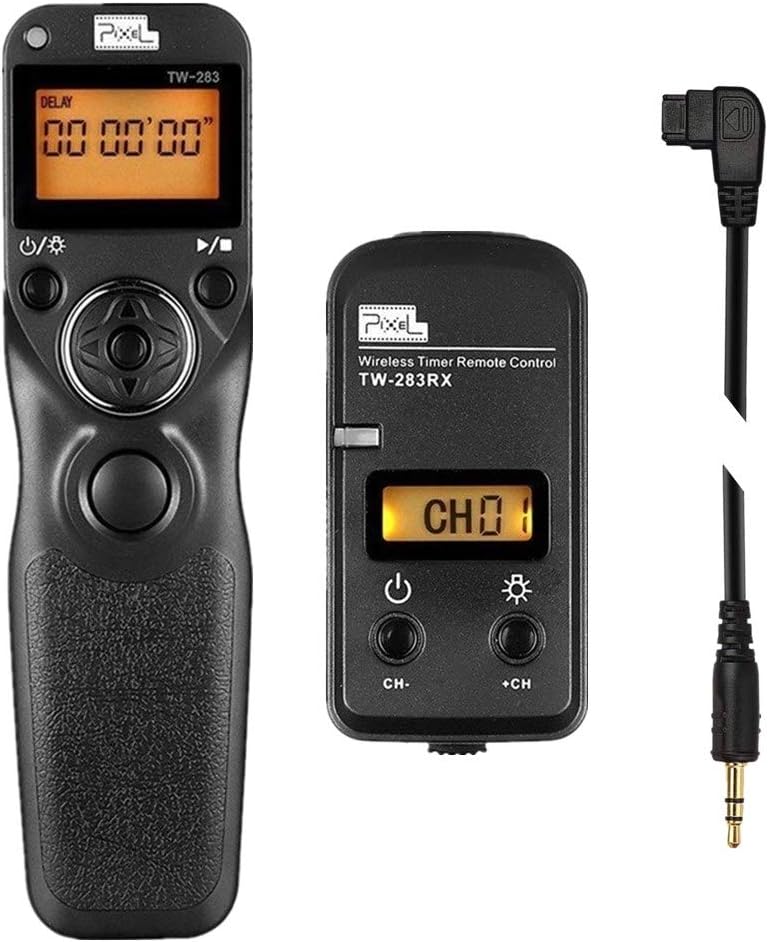
Pros
- Exceptional 80m wireless range with no directionality
- Robust timer functions supporting up to 999 shots and unlimited loops
- User-friendly LCD for easy mode and timer configuration
- Long battery standby: over 1000 hours transmitter, 400 hours receiver
Cons
- Batteries not included, requiring four AAA cells
- Transmitter size may feel bulky for pocket carry
- Occasional setup issues with battery polarity reported
The Pixel TW283-S1 is a versatile wireless remote shutter release and intervalometer designed for Sony photographers using A-series DSLRs, SLT models, and select Konica Minolta cameras. It targets users needing precise control for time-lapse sequences, long bulb exposures, self-portraits, or group shots where the shooter must be in the frame, eliminating camera shake and built-in timer limitations.
Standout features include an 80m wireless range with 360-degree no-directionality transmission, 30 selectable channels for anti-interference, and comprehensive timer controls: delay from 1-59s, intervals up to 99 hours, up to 999 shots per sequence, and unlimited repeats. Real-world performance shines in scenarios like sunrise timelapses or flower blooming captures, with modes for single, continuous, bulb, and delay shooting ensuring flexibility without constant camera access.
Build quality features a clear LCD on both transmitter and receiver for intuitive settings, compact receiver dimensions, and lightweight design. Battery life is impressive at over 1000 hours standby for the transmitter. The 2.4GHz FSK system and interchangeable S1 cable support wired fallback, making it reliable in varied environments.
Potential drawbacks include no included batteries, requiring careful AAA installation to avoid LED issues, and a somewhat larger transmitter profile. Compatibility is broad but model-specific, so verify your camera.
Overall, the TW283-S1 delivers professional-grade remote control at an accessible level, earning its place for intermediate to advanced Sony shooters prioritizing automation and distance.
Wireless Tech: 2.4GHz FSK, 30 channels, 80m+ range
Timer Functions: Delay 1-59s, interval up to 99:59:59, shots 1-999, repeats 1-99 or unlimited
Dimensions: Transmitter 146x40x19mm (52.6g), Receiver 73x38x31mm (36.2g), excl. batteries
Battery Life: Transmitter >1000hrs, Receiver >400hrs (2x AAA each)
Modes: Single, continuous, bulb, delay, timer schedule
Compatible with Sony ILCA-77M2, 99M2, 99V; DSLRs A100-A900 series; SLTs A33-A99; Konica Minolta Dynax 5D/7D, DiMAGE A1-A2, 3-9 series. Uses S1 shutter cable.
Pros
- Ultra-precise timing up to 99:59:59 for professional time-lapse projects
- Multiple modes including self-timer, continuous, and long exposure
- Broad compatibility with Canon EOS Rebel, R series, and more
- Compact design with humanized backlight for low-light use
- Functions without batteries as a basic wired shutter release
Cons
- No memory function; settings reset when powered off
- Cannot control video recording or lens zoom
- Maximum timer limited to under 100 hours, requiring reset for longer projects
The JJC Intervalometer is a versatile wired timer remote designed for Canon EOS photographers, including Rebel T7, T6, 90D, 80D, R6, R10, and RP models. It excels in time-lapse photography, allowing users to set delays, exposure times, and intervals up to 99 hours 59 minutes 59 seconds, with options for 1-399 shots or unlimited. Ideal for capturing dynamic scenes like blooming flowers, waterfalls, or traffic streams without introducing camera shake.
Standout features include self-timer, continuous shooting, long exposure timer, and a bulb mode slider for extended shots. In real-world use, it delivers reliable performance for astrophotography or nature sequences, with the interval including exposure time for accurate spacing, such as 10-second exposures every 15 seconds for a 5-second gap. The backlit LCD makes adjustments simple in dark conditions, enhancing usability during night shoots.
Build quality is solid with a compact 12.1x4x2.1cm body and 90cm cable, powered by two AAA batteries. It doubles as a manual remote without power, perfect for quick snapshots. However, it lacks a memory function, so settings must be re-entered after powering off, and it does not support video control or zoom.
Overall, this intervalometer is a must-have for intermediate to advanced photographers focused on creative time-lapse and long-exposure work, offering exceptional value for its precision and compatibility.
Self-timer, interval timer, long-exposure timer, and exposure-count settings for versatile control.
Timers adjustable from 1 second to 99 hours 59 minutes 59 seconds in one-second increments.
Compact size with 90cm cable and backlit LCD for dark environments.
Battery-free manual mode for focus, shutter, and bulb lock.
Canon EOS Rebel T7 T6 T5 T3 T8i T7i T6s T6i T5i T4i and more; 90D 80D 70D 77D 2000D; R R6 Mark II III R7 R8 R10 R50V R100 RP; M6 Mark II M5; Powershot G16 G15 G12 etc.; Pentax K30 K50 K1 K3 etc.
Pros
- Highly precise timing for professional time-lapse results
- Versatile manual mode works without batteries
- Compact design with long cable for portability
- Backlit display enhances usability in the dark
- Supports self-timer, continuous, and exposure count settings
Cons
- No memory function; settings reset when powered off
- Cannot control video recording or lens zoom
- Maximum total interval limited to under 100 hours
The JJC Intervalometer is a wired timer remote control designed for a wide array of Sony cameras, including A6000 series, A7 models, RX100, ZV-1, and more. It targets photographers interested in time-lapse photography, long exposures, and shake-free shooting, such as astrophotographers capturing star trails or nature enthusiasts documenting growth sequences.
Standout features include interval timing from 1 second to 99 hours 59 minutes 59 seconds, self-timer, bulb mode with slide-lock, and exposure counts up to 399 or unlimited shots. In real-world use, it excels at automating series like waterfalls or traffic lights, with the interval including exposure time for accurate gaps. The backlit LCD ensures visibility in dark conditions, and it doubles as a simple manual remote without batteries.
Build quality is solid with a compact 12.1x4x2.1cm body and 90cm cable, powered by two AAA batteries. It feels reliable for fieldwork, though the lack of settings memory means reprogramming after power cycles.
Drawbacks include no video or zoom control, and the 100-hour limit suits most projects but not multi-day timelapses without intervention. Settings must be re-entered each time.
Overall, this is a powerful tool for Sony shooters needing advanced timer functions at an accessible level, delivering professional results for time-lapse and long-exposure work.
Compatible with Sony A6000 / A6100 / A6300 / A6400 / A6500 / A6600 / A3000 / A3500 / A5000 / A5100 / A58; A1 II / A1 / A9 / A9 II / A9 III / A7 / A7 II / A7 III / A7 IV / A7R / A7R II / A7R III / A7R IV / A7R V / A7S / A7S II / A7S III / NEX-3NL; DSC-HX300 / HX400 / HX400V / HX50V / HX60V / HX90 / HX90V; DSC-RX10 / RX10 II / III / IV; RX100 II-VII / VA / RX1R II / WX500 / ZV-1; FX3 / FX30.
Note: Not compatible with A7C, A7C II, A7CR. Verify your model before purchase.
Pros
- Highly precise timing for professional time-lapse results
- Long cable reduces camera shake effectively
- Backlit display for nighttime usability
- Versatile manual mode without batteries
- Broad Nikon compatibility across models
Cons
- No memory function; settings reset when powered off
- Cannot control video recording or lens zoom
- Interval time includes exposure, requiring manual calculation for gaps
The JJC Intervalometer is a compact wired remote shutter release designed for Nikon photographers who specialize in time-lapse, long exposures, and bulb photography. It targets users of models like the Z6 III, Z7 II, D750, D780, D7500, and many others, enabling automated shooting sequences without touching the camera to prevent shake.
Standout features include self-timer, interval timer, long-exposure timer, and shot counting, with settings adjustable from 1 second to 99 hours 59 minutes 59 seconds. In real-world use, it excels at capturing blooming flowers, starry skies, waterfalls, or traffic trails, delivering reliable performance for sequences up to 399 shots or unlimited. The backlit LCD ensures easy operation in low light, and the 90cm cable provides flexible positioning.
Build quality is solid with a compact 12.1x4x2.1cm design powered by two AAA batteries, feeling durable for fieldwork. It doubles as a simple manual remote without batteries, perfect for quick shots or bulb mode. Drawbacks include no settings memory, so reprogramming is needed after power cycles, and intervals incorporate exposure time, demanding careful setup.
Overall, this is a must-have tool for Nikon time-lapse enthusiasts seeking affordable precision and versatility, earning high marks for functionality despite minor usability quirks.
Compatible with Nikon Mirrorless: Z6 III, Z6 II, Z6, Z7 II, Z7, Z5.
DSLR: D90, D600, D610, D780, D750, D3100, D3200, D3300, D5000, D5100, D5200, D5300, D5500, D5600, D7000, D7100, D7200, D7500, Df.
Point-and-Shoot: Coolpix P7700, P7800, P1000, P1100.
For time-lapse of events under 100 hours, set BULB exposure time and INTERVAL (which includes exposure), then N for shot count. Example: 10s exposure, 5s gap needs 15s interval, N=50.
No video or zoom control. Use manual mode without batteries for basic remote triggering. Resets to zero on power off, so note your settings.
Pros
- Extensive Canon EOS compatibility including R5, R3, 5D series
- Versatile timing from 1 second to 99:59:59
- No camera shake with wired tethered control
- Humanized backlight for low-light operation
- Simple bulb lock for extended exposures
Cons
- Settings reset to zero when powered off
- No control for video recording or lens zoom
- Maximum timer limited to under 100 hours
The JJC TC-80N3 is a compact wired intervalometer designed for Canon EOS photographers seeking advanced exposure control. It excels in time-lapse photography, long exposures, and self-timer functions, making it ideal for capturing blooming flowers, sunsets, star trails, waterfalls, and traffic flows without introducing camera shake.
Standout features include customizable self-timer, interval timer, long-exposure timer, and exposure count settings, with timers adjustable from 1 second to 99 hours 59 minutes 59 seconds. In real-world use, it delivers reliable performance for sequences up to 399 shots or unlimited, and the interval includes exposure time for precise gaps, like 10-second exposures every 15 seconds. It also serves as a manual remote without batteries, with half-press focus and full-press shutter, plus bulb lock by sliding the button up.
Build quality is solid with a compact 12.1x4x2.1cm body, 90cm cable for reach, and power from 2 AAA batteries. The backlit LCD ensures visibility in dark conditions, enhancing usability during night shoots.
Drawbacks include no memory function, so settings reset on power-off, requiring reconfiguration each time. It lacks video or zoom control, and the 100-hour max limits ultra-long projects like 10-day timelapses.
Overall, the TC-80N3 offers exceptional value for Canon users advancing into time-lapse and astrophotography, delivering professional results at an accessible level. Highly recommended for creative photographers.
Works with Canon EOS R5 Mark II, R5, R3, R1, 5D Mark IV/III/II, 5Ds/5Ds R, 6D Mark II/6D, 7D Mark II/7D, 1Dx Mark III/II, 1Ds Mark III/II, 50D, 40D, and more including 1D series, 30D, 20D, 10D, EOS 1V, EOS 3, EOS D2000.
Self-timer, interval timer, long-exposure timer, and exposure-count settings. Timers up to 99:59:59. Backlit LCD. 90cm cable. Powered by 2 AAA batteries. Manual remote mode without batteries. Compact size: 12.1x4x2.1cm.

Pros
- Exceptional 80m wireless range with no directionality
- Versatile timer functions for professional time-lapse and bulb shooting
- Clear LCD screen for intuitive mode and timer adjustments
- Strong anti-interference with 30 selectable channels
- Broad compatibility with many Olympus OM-D, PEN, and Stylus models
Cons
- Batteries not included, requires four AAA batteries
- Incompatible with newer Olympus models like E-M1 II, E-M5 III, and E-M10 III/IV
- Timer functions require manual focus on the camera
The Pixel TW283-UC1 is a versatile wireless remote shutter release and intervalometer designed for photographers using compatible Olympus cameras such as the OM-D E-M1, E-M5 Mark II, E-M10 Mark II, PEN-F, and various E-PL and Stylus models. It targets enthusiasts and professionals who need precise control over single shots, continuous shooting, bulb exposures, and advanced time-lapse sequences without touching the camera, reducing shake and enabling creative setups like self-portraits from afar or unattended timelapses.
Standout features include an 80m wireless range with 360-degree no-directionality transmission via 2.4GHz FSK technology and 30 channels to dodge interference. The intervalometer supports customizable delay, interval, exposure, and repeat timers up to 99 hours 59 minutes 59 seconds, with shot counts up to 999 per sequence and unlimited loops. Real-world performance shines in scenarios like capturing blooming flowers or sunsets, where users set parameters once and let the device handle the rest, delivering reliable triggers even at maximum distance.
Build quality is solid with a lightweight transmitter (52.6g) and receiver (36.2g), both featuring clear LCD displays for easy navigation. The 2-in-1 design allows wired use as a backup, and interchangeable cables expand compatibility. Battery life impresses with over 1000 hours standby on the transmitter.
Drawbacks include the lack of included batteries and incompatibility with newer Olympus models like E-M1 II or E-M5 III, requiring the E3 variant instead. Timer modes also need manual focus enabled on the camera.
Overall, the TW283-UC1 delivers pro-level remote control at an accessible level, earning its solid reputation for Olympus users seeking freedom in timing critical shots. Highly recommended for landscape, astrophotography, and macro time-lapse work.
Wireless Range: 80m / 262ft, 360° no directionality
Technology: 2.4GHz FSK, 30 channels
Timer Functions: Delay (1-59s), Interval up to 99:59:59, Shots (1-999), Repeats (1-99 or unlimited)
Shooting Modes: Single, Continuous, Bulb, Delay
Battery Life: Transmitter >1000hrs, Receiver >400hrs (2x AAA each, not included)
Dimensions: Transmitter 146x40x19mm, Receiver 73x38x31mm
Compatible with: Olympus OM-D E-M1, E-M5 Mark II, E-M5, E-M10 Mark II, E-M10; PEN-F, E-PL8 to E-PL2, E-P5 to E-PM1, E30 to E620, SP-510UZ to 810UZ, XZ-1/2, Stylus 1/s, SP-100EE, SH-60 to SH-1, SZ-31MR to SZ-10, SH-21/25.
Not compatible: OM-1, OM-5, E-M1X/II/III, E-M5 III, E-M10 III/IV (use Pixel E3 model instead).
Best Intervalometers Buying Guide
Camera Compatibility
Top intervalometers shine with broad compatibility across Canon, Nikon, Sony, and Olympus cameras, ensuring seamless integration for your specific model. Prioritize ones matching your gear to avoid setup hassles during outdoor shoots or studio sessions.
For drone photographers capturing aerial time-lapses, check models supporting mirrorless systems; explore our drones category for complementary gear that pairs perfectly with precise remotes.
Timer Functions and Interval Accuracy
Look for robust interval, long exposure (bulb), and self-timer modes with customizable settings down to one-second precision. In real-world use, these deliver consistent shots for star trails or blooming flowers without missing frames.
| Function | Ideal Use Case |
| Interval Timer | Time-lapse sequences |
| Bulb Mode | Long exposures |
| Self-Timer | Group shots, stability |
Wired vs Wireless Reliability
Wired options offer unerring reliability for tethered setups, while wireless models provide freedom up to 100m range, ideal for remote landscapes. We recommend wireless for mobility but verify battery life exceeds 24 hours for extended sessions.
Final Thoughts
The JJC Intervalometer for Canon earns Best Overall for its versatile compatibility, precise controls, and outstanding real-world reliability across time-lapse and bulb shooting. JJC for Nikon takes Best Value with essential features at an unbeatable entry point. For Sony shooters, the dedicated JJC model excels in mirrorless integration. Choose yours today and elevate your photography; see more in our drones section.
FAQs
What is an intervalometer and why do you need one in 2026?
An intervalometer is a remote timer that automates shutter releases at set intervals, perfect for time-lapse or long exposures without touch-induced shake. In 2026, advanced models add programmability for professional results in any lighting.
How do I pick the Best Intervalometers for my camera brand?
Match the model to your camera’s port (e.g., 2.5mm or 3-pin) and verify compatibility lists for EOS, A7, or Z-series. Broad support ensures future-proofing for your evolving kit.
Are wireless Best Intervalometers reliable for outdoor use?
Yes, top wireless intervalometers maintain signal over 100m line-of-sight with minimal interference, backed by long battery life. Test in your environment for peak performance; grab one from our top picks to start shooting confidently.
Can Best Intervalometers improve time-lapse photography?
Absolutely, by enabling precise intervals and exposure bracketing, they eliminate manual timing errors. Pair with our recommended models for smooth workflows in streaming sunsets or urban motion captures.
What’s the difference between wired and wireless Best Intervalometers?
Wired delivers zero-latency reliability for studio work, while wireless offers mobility for field shoots. Both excel in build quality; see our cameras guide for setup tips.
Sources
This article was researched and written with reference to expert reviews and testing data from trusted sources including DPReview, PetaPixel, TechRadar, CNET, Imaging Resource, and Photography Life. All recommendations reflect real-world performance and value as of October 2026.




Write Your Review
No reviews yet. Be the first to share your experience!